

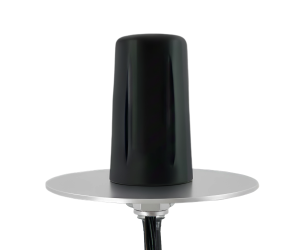
Have you ever installed a high-gain 4G/5G antenna only to find your speeds are still sluggish? The problem might not be the antenna itself. It could be missing its most important partner: the ground plane.
While it sounds technical, a ground plane is a simple concept that can make or break your wireless connection. If you’re using cellular or WiFi antennas, knowing how this works is the secret to professional-grade performance.
The "Radio Mirror" Effect
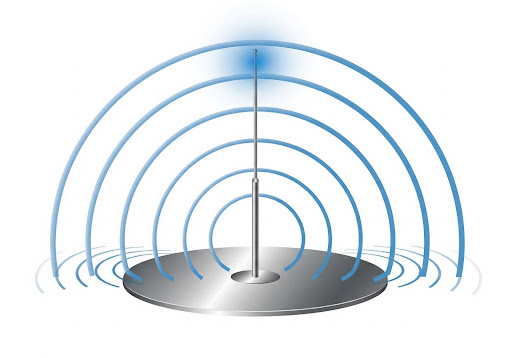
Imagine you have a light bulb in the middle of a dark room. It throws light in every direction. Now, place a mirror directly underneath it. Suddenly, all that light that was heading toward the floor is reflected upward, making the room much brighter.
An antenna ground plane works exactly like that mirror, but for radio waves. Many common antennas—technically called "monopoles"—are electrically only half an antenna. They need a flat, conductive surface (the ground plane) to act as the "other half."
When the signal hits the metal ground plane, it reflects. This reflection combines with the original signal to create a complete, powerful radio wave pattern. Without it, your signal is weak, lopsided, and much shorter in range.
Why Some Antennas Don't Need One
You might notice some antennas mounted on wooden poles or plastic boxes. These are "No Ground Plane" (NGP) antennas. Engineers have essentially built the "mirror" right into the antenna casing. While convenient, these are often larger and more expensive than standard antennas that rely on an external metal surface.
Size and Frequency: The Perfect Fit
How big does your ground plane need to be? It depends on the frequency of the signal you are using (like 700 MHz for 4G or 5 GHz for WiFi).
Radio waves are like ripples in a pond. Lower frequencies have long, slow ripples; higher frequencies have short, fast ripples. A ground plane must be large enough to "catch" these ripples. A good rule of thumb is that the metal surface should extend at least one-quarter of a wavelength in every direction from the base of the antenna.
Here is a simple comparison of ground plane size requirements:
Antenna Technology | Approximate Frequency Range | Wavelength | Minimum Ground Plane Diameter (approx.) |
Low-Band 4G/5G | 600 - 800 MHz | Long | Needs a large surface |
Mid-Band 4G/5G/WiFi | 1.7 - 2.6 GHz | Medium | Needs a moderate surface |
High-Band 5G/WiFi | 5 GHz | Short | Needs a small surface |
Using a ground plane that is too small will result in poor performance, a misshapen radiation pattern, and a high SWR (signal waste).
Where to Place the Antenna
To get a clear signal in all directions (omni-directional), always place your antenna in the center of the ground plane. If you place it at the edge, the signal will be "pulled" toward the metal, making your connection strong in one direction but very weak in the other.
Acceptable Materials
You don't need fancy aerospace materials. Anything that conducts electricity well will work! Common choices include:- Steel (like a car roof or heavy machinery)
- Aluminum (like a specialized mounting plate)
- Copper or Brass
Safety First: RF Ground vs. Electrical Ground
It is very important not to confuse an RF Ground Plane with Electrical Grounding.- RF Ground: Creates the "mirror" to improve your radio signal.
- Electrical Ground: Protects you from shocks and diverts lightning safely to the earth.
Example Proxicast Antennas
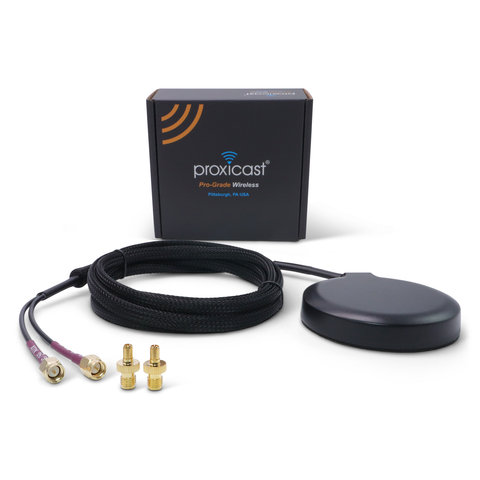
Ground Plane Required: Magnetic Mount Antenna - ANT-122-M19
This antenna requires a ground plane. Its magnetic base is designed to stick to the metal roof of a vehicle, which then acts as the ground plane for maximum signal.
View Product
Ground Plane Independent: Fiberglass Omni - ANT-127-002
Perfect for mounting on wooden poles or non-metal buildings. This antenna does not require an external ground plane for operation.
View Product