

Understanding Antenna Gain: It's About Focus, Not Magic Power
Have you ever wondered how swapping the small antenna on your router or cellular modem for a larger one can suddenly give you a better signal?
It isn't magic; it's physics. The secret lies in a concept called antenna gain.
What is Antenna Gain? (Hint: It’s About Focus)
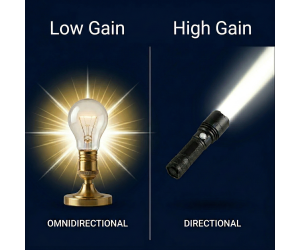
In simple terms, antenna gain does not create more radio energy. Instead, it focuses the energy it already has into a specific direction. Think of a standard lightbulb. It shines light in almost every direction equally. Now, think of a flashlight. It has a reflector behind the bulb that focuses that same amount of light into a single, bright beam. Antennas works the same way. Remember that light is just radio frequencies that you can see:
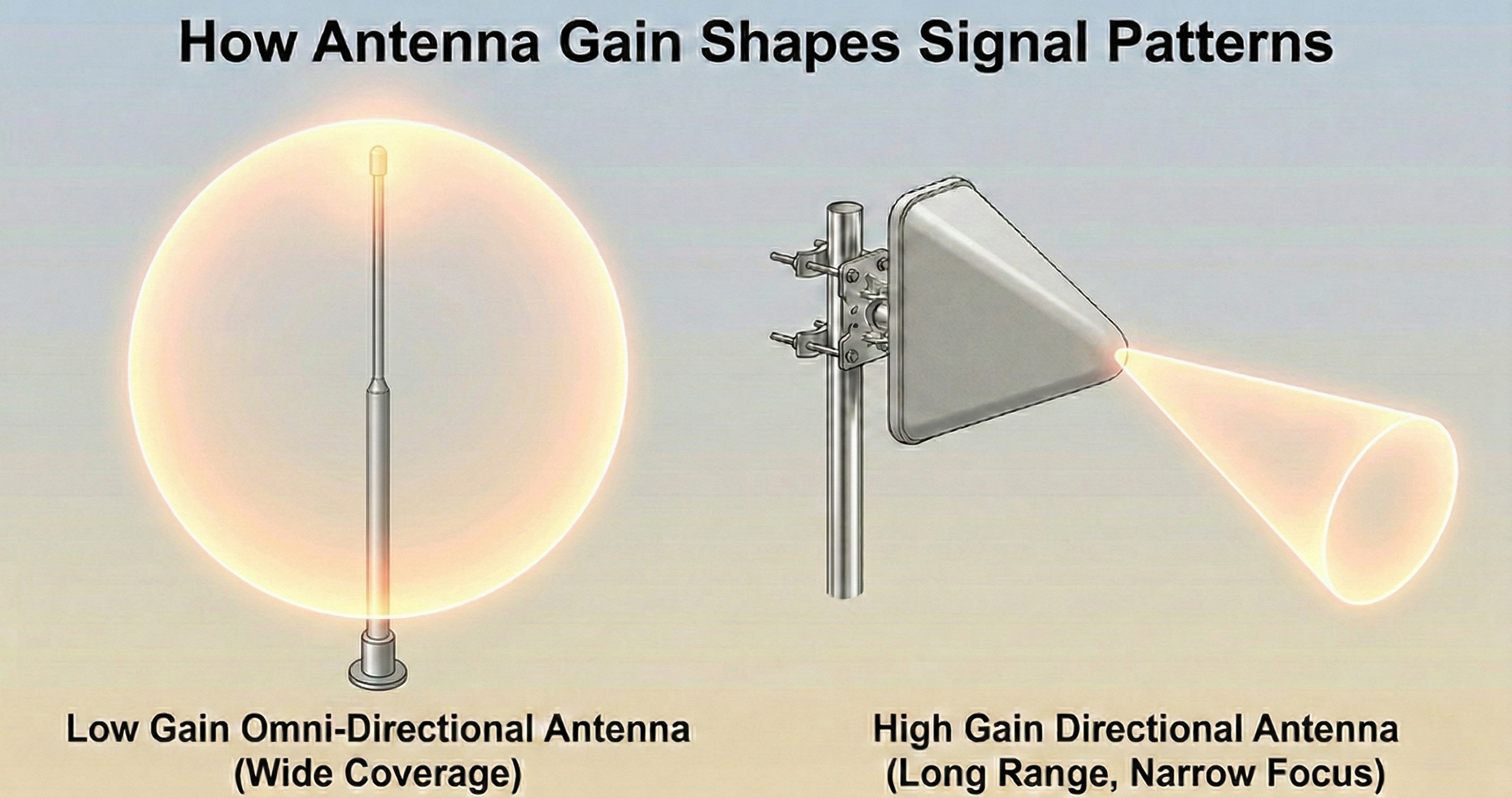
- Low-Gain (Omnidirectional): Like the lightbulb, it sends and receives signals in a wide, donut-shaped pattern.
- High-Gain (Directional): Like the flashlight, it squishes that donut into a long, narrow beam.
How Gain Shapes the Radiation Pattern
By focusing the signal, the antenna gain factor determines the "radiation pattern." A high-gain antenna has a narrow pattern, meaning you must point it exactly at a cell tower to get a signal. A lower-gain antenna is more "forgiving" because it "listens" in almost all directions at once. This focus is often assisted by a ground plane, which is a flat, conductive surface that acts as one half of a complete antenna system. The ground plane reflects the signal, helping shape the radiation pattern and effectively increasing the antenna's gain. See our tutorial on Ground Planes.
Antenna gain is usually measured in dBi (decibels relative to an isotropic radiator). The higher the dBi number, the more focused the signal.
Choosing the Right Omni: Low, Medium, or High?
When selecting an omnidirectional antenna, the "gain" you choose depends on your location. Because these antennas can't create power, they increase gain by "squashing" the vertical signal to push it further horizontally. This is the same principle where ground planes reflect signals up and out to communicate with distant towers.
Low-Gain Omni |
 |
Low-gain antennas produce a signal shape that resembles a fat donut. This pattern radiates energy broadly, including upward and downward. | Best For: Mobile applications like boats or RVs that rock and tilt, and urban areas where signals bounce off buildings. |
Medium-Gain Omni |
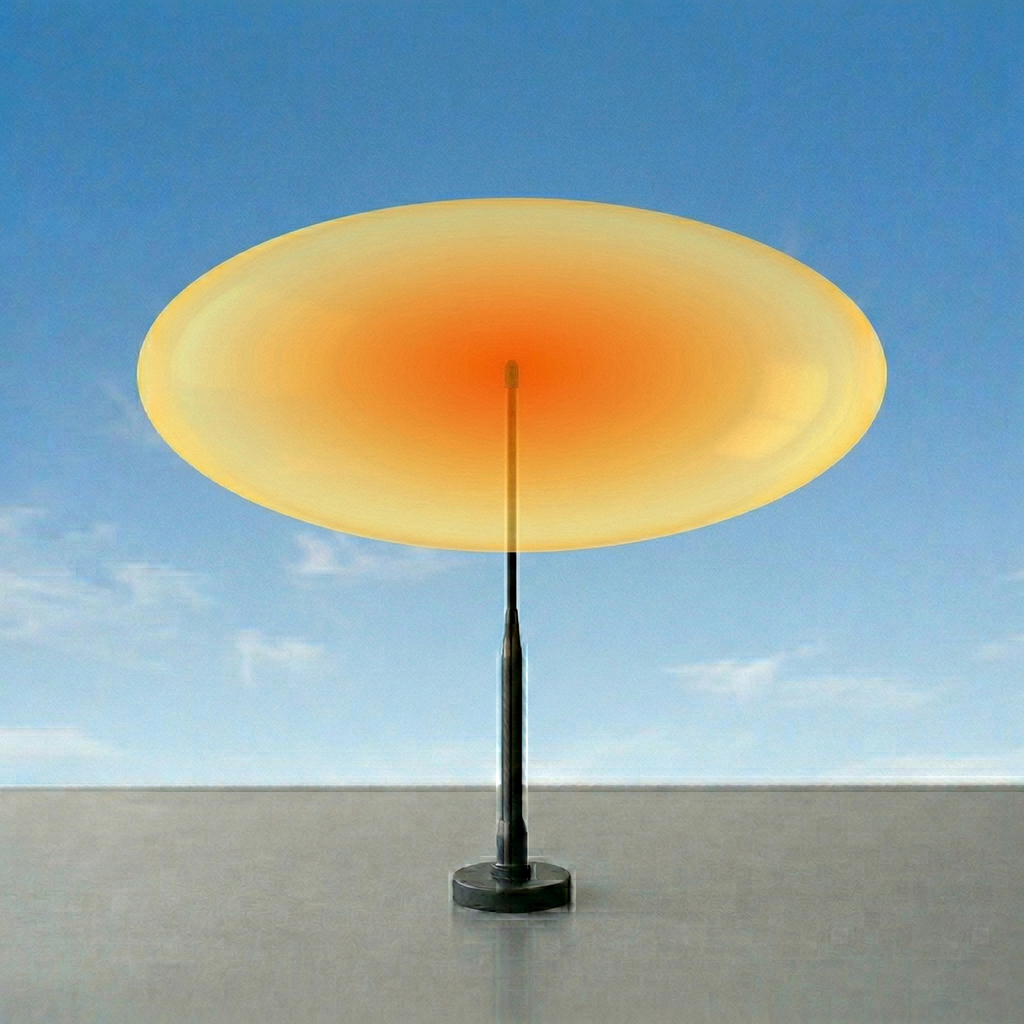 |
These are the "all-rounders." They begin to flatten the signal "donut," pushing energy further toward the horizon while still maintaining enough vertical signal for uneven terrain. | Best For: Flat, rural areas where the cell tower is very far away. |
High-Gain Omni |
 |
High-gain antennas squash the pattern into a very thin, flat disk. This projects the signal much further along the horizon at the expense of vertical coverage. | Best For: Flat, rural areas where the cell tower is very far away.
The Risk: In hilly areas, the flat "disk" might overshoot a tower in a valley or undershoot one on a hill. High gain antennas are more susceptible to line-of-sight interference from trees and buildings. |
The Frequency Connection
It's important to know that an antenna's gain isn't a single, fixed number. It changes depending on the frequency of the signal. A "5 dBi" antenna might only have that gain at a specific frequency, like 1900 MHz. At 700 MHz or 2600 MHz, its gain could be higher or lower. A "wideband" antenna is designed to have a relatively consistent gain across many of these frequencies.
Frequency also dictates hardware size: the lower the frequency, the longer the wavelength. This means you need larger components—such as a taller antenna and a larger ground plane surface — to match those longer waves. For example, low-band 4G/5G (600–800 MHz) needs a large surface like a car roof, while high-band 5G or WiFi (5 GHz) has short wavelengths and can use a much smaller ground plane.
Antenna Gain and Your Signal "Bars"
Those signal bars on your phone or modem are a simple representation of complex signal measurements. More bars means you are receiving more radio energy, not necessarily a higher quality signal. Here’s a look at the key parameters you should monitor:
| Parameter | Full Name | What It Means | How High Gain Helps |
|---|---|---|---|
| RSSI | Received Signal Strength Indicator | A simple measure of total received power, including noise. | Increases total received power, including noise. |
| RSRP | Reference Signal Received Power | Crucial for LTE/5G. Measures the power of the specific signal from your tower, ignoring noise. | Directly increases RSRP by focusing on the tower's signal. A less negative number (e.g., -80 dBm is better than -100 dBm) is good. |
| RSRQ | Reference Signal Received Quality | A measure of signal quality that indicates how loaded the tower is. | Can indirectly improve RSRQ by providing a stronger, cleaner RSRP. |
| SINR | Signal-to-Interference-plus-Noise Ratio | The best measure of signal quality. It's the ratio of your good signal to all the background noise and interference. | Greatly improves SINR. A directional antenna focuses on the wanted signal and ignores unwanted noise from other directions. A higher number (e.g., >20 dB) is excellent. |
When Higher Gain is NOT the Answer
So, should you always buy the antenna with the highest gain? Absolutely not. Remember the flashlight? A tightly focused beam is useless if you need to light up an entire room.
Here are situations where a lower-gain, omnidirectional antenna is a better choice:
|
|

A Quick Word on MIMO
Modern 4G and 5G devices use MIMO (Multiple-Input Multiple-Output) technology. This means they use multiple antennas at once to send and receive data. While gain helps each individual antenna, MIMO allows them to work together to significantly boost your speed and reliability. We will cover MIMO in detail in a future blog post!
Conclusion
Antenna gain is a powerful tool for improving your 4G/5G signal, but it's not a one-size-fits-all solution. It's about choosing the right tool for the job: a "flashlight" for long-range, line-of-sight connections, and a "lightbulb" for broad coverage in complex environments. By understanding the trade-offs, you can select the perfect Proxicast antenna for your specific needs.